I needed a screwdriver. A small one, the kind that tightens the arm of a pair of glasses, which is a very specific need at 8:15 on a weekday morning.
What I found was eleven pens, a charging cable for a phone I have not owned in years, a single AA battery of unknown moral character, and a key that opens nothing in this building. I know it opens nothing because I have tried every door, twice, in a spirit of hope.
No screwdriver.
You know the drawer. It opens about three inches and then something wedges, and there’s a whole ritual to it: the lift, the shimmy, the flat hand slid in on top to press the contents down while you pull. I have performed this maneuver with a phone pinned between my shoulder and ear, telling my sister that yes, I’m listening, while a tape measure fought me for territory.
For about a year I treated that drawer as a personal failing. Proof that I was secretly a slob wearing the costume of a tidy adult. I read enough about organizing to know the accepted position, which is that a junk drawer is clutter and clutter is bad and a properly run home would simply not have one.
I now think that’s nonsense.
The drawer isn’t the problem, the dead end is
Here’s what I eventually noticed. Every single thing in that drawer arrived there for a real reason: it had no category. A home is full of things that fit neatly somewhere. Forks go with forks. Socks go with socks. But then there is the spare washer from the tap repair, the tiny screw that came in the box with the shelf, the pen you actually like, the takeaway menu, the allen key, the packet of picture hooks. These things are not junk. They are uncategorized, which is a completely different condition.
If you refuse to give uncategorized things a home, they don’t vanish. They colonize. They end up in a bowl on the counter, then a second bowl, then the windowsill, then the spot by the kettle where you put the mail. I’ve lived that version. It’s worse. A junk drawer is a home admitting the truth about itself, which I find sort of dignified.
The actual problem is that mine had no exit. Things went in and nothing ever came out under its own steam. It was a landfill with a handle. Every drawer needs an entrance and an exit, and mine had been running on entrance only since the day I moved in.
That’s the same failure I make everywhere, honestly. It’s why decluttering sometimes makes the mess worse for a week: I pull everything out and create four new piles with no destination for any of them.
So I gave the drawer a job description
This sounds precious. It took eleven minutes and it has held for a long time now, so I’ll wear the preciousness.
I emptied it onto the kitchen table and wrote, on an index card, what the drawer was for: small household tools, fixings, and things needed within arm’s reach of the kitchen. That was it. Then I looked at the pile through that sentence. Sunglasses case? Not household tools. Birthday candles? Fine, arm’s reach, stays. Nine of the eleven pens? Not a chance. Eleven pens is not a supply of pens, it’s a monument.
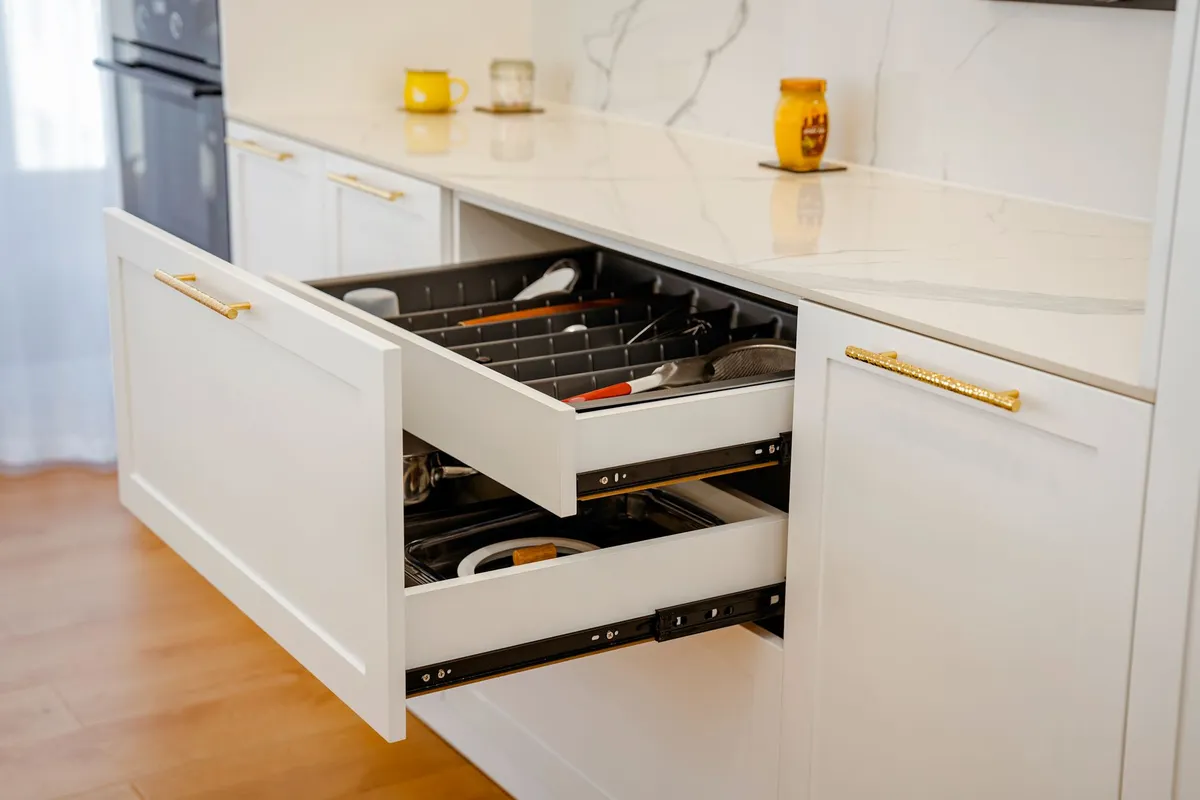
Then, the part that mattered more than the culling: I bought a set of small plastic bins that fit the drawer’s width, the boring shallow kind, and filled the whole space so there was no free floor left. Compartments do something a drawer alone can’t, which is stop the shuffle. Loose items migrate. Items in a box the size of a deck of cards sit still and get found. The screwdriver has a slot now. It lives there like a tenant with a lease.
And the exit. Once a month, when I change the bed sheets, I open the drawer and give it five minutes. Not a reorganization, just a sweep: anything that isn’t in the job description goes to where it belongs or into the bin. Five minutes, attached to a chore I already do without thinking, the same logic that makes the night-before version of a morning routine actually stick. Habits need a host.
Three questions and the things you’ll always hunt for
When something lands in your hand and you don’t know where it goes, ask:
- Does this belong to a category that already exists somewhere in the house? Then walk it there. The drawer is not a waiting room for things with real homes.
- If I needed this, would I look for it in the kitchen? A phone charger, yes. A car manual, no.
- Would I be sad if this were gone in a month? If the answer is no, you’re storing it out of politeness to a past version of yourself.
That last one gets the mystery keys, eventually. I kept mine for another six months, for the record. Progress isn’t purity.
And the hunted things, the ones you paw through drawers for at bad moments: scissors, tape, a pen that works, a small screwdriver, batteries, a flashlight. Those six earn permanent compartments, and you don’t let anything share their space. Everything else in the drawer is a guest.
The drawer still has junk in it. That’s the job. It just can’t keep it anymore.
Frequently asked questions
How many junk drawers should a house have?
One per floor or one per zone is plenty, usually the kitchen and maybe an entryway. More than that and you stop knowing which drawer you last saw the tape in, which defeats the whole point.
Do I really need containers, or can I just tidy it?
Tidying alone lasts about a week, because loose items shuffle every time the drawer opens. Compartments that fill the whole drawer are what keep things from migrating.
What should never live in a junk drawer?
Anything important or anything with a real home: documents, medication, keys you actually use, warranty paperwork. If losing it for a month would be a problem, it needs a proper spot.